
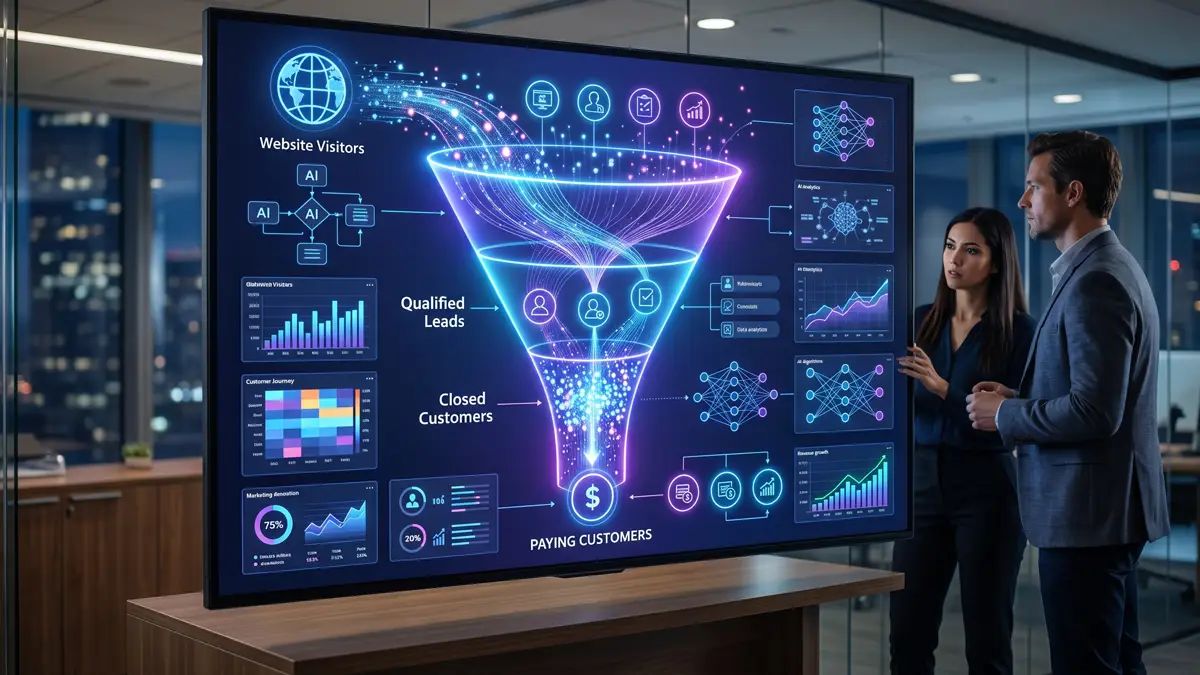
AI Sales Funnel Strategies
AI Sales Funnel Strategies: How to Turn More Visitors into Customers in 2026
Businesses today are generating more traffic than ever before. Between social media, search engines, paid ads, email marketing, and content marketing, attracting visitors is no longer the biggest challenge. The real challenge is converting those visitors into paying customers.
This is where AI-powered sales funnels are changing the game.
Artificial intelligence has transformed traditional sales funnels by helping businesses understand customer behavior, personalize interactions, automate repetitive tasks, and optimize conversions at every stage of the buyer journey.
Whether you’re running an eCommerce store, a SaaS company, a digital agency, or an online course business, AI can help you build smarter sales funnels that generate better results with less manual effort.
In this guide, we’ll explore the most effective AI sales funnel strategies that businesses are using in 2026 to increase leads, improve conversion rates, and maximize revenue.
What Is an AI Sales Funnel?
An AI sales funnel is a customer acquisition and conversion process enhanced by artificial intelligence.
Instead of relying on generic marketing messages and manual decision-making, AI analyzes user behavior, predicts customer intent, and automates personalized interactions.
A traditional sales funnel usually follows these stages:
- Awareness
- Interest
- Consideration
- Decision
- Purchase
- Retention
AI helps optimize each stage by delivering the right message to the right person at the right time.
The result is a more efficient funnel that converts prospects into customers faster.
Why AI Sales Funnels Matter
Consumer expectations have changed dramatically.
Modern buyers expect:
- Personalized experiences
- Instant responses
- Relevant recommendations
- Seamless customer journeys
If businesses fail to meet these expectations, potential customers often leave and purchase from competitors.
AI helps businesses:
- Increase lead quality
- Reduce customer acquisition costs
- Improve conversion rates
- Automate repetitive tasks
- Scale marketing operations
- Deliver better customer experiences
According to industry reports, companies using AI-driven marketing and sales tools consistently achieve higher conversion rates compared to businesses relying solely on traditional methods.
Strategy 1: Use AI for Smarter Audience Segmentation
Not all visitors are the same.
Some are ready to buy immediately, while others are simply researching options.
AI can automatically segment users based on:
- Browsing behavior
- Purchase history
- Location
- Demographics
- Engagement levels
- Content consumption patterns
Instead of sending identical marketing messages to everyone, businesses can create highly targeted campaigns for different audience segments.
Example
An online software company could identify:
- First-time visitors
- Returning visitors
- Trial users
- High-intent prospects
- Existing customers
Each group receives personalized messaging that matches their position in the funnel.
This significantly improves conversion rates.
Strategy 2: Implement AI-Powered Lead Scoring
One of the biggest challenges for sales teams is identifying which leads deserve attention.
AI lead scoring solves this problem.
Machine learning algorithms analyze hundreds of behavioral signals to determine how likely a prospect is to convert.
Factors include:
- Website visits
- Email engagement
- Demo requests
- Social interactions
- Time spent on key pages
Instead of manually evaluating leads, AI automatically prioritizes the most promising opportunities.
Benefits include:
- Faster sales cycles
- Better sales efficiency
- Higher close rates
Strategy 3: Personalize Landing Pages Dynamically
Generic landing pages often fail because they don’t address individual customer needs.
AI can dynamically customize landing page content based on visitor behavior.
Elements that can change include:
- Headlines
- Product recommendations
- Call-to-action buttons
- Images
- Testimonials
- Pricing displays
Example
A visitor arriving from a Facebook ad may see a different message than someone arriving through Google search.
This level of personalization creates a more relevant experience and improves conversions.
Strategy 4: Use AI Chatbots for Instant Engagement
Many potential customers leave websites simply because they cannot get answers quickly.
AI chatbots solve this issue by providing instant support 24/7.
Modern AI chatbots can:
- Answer common questions
- Recommend products
- Schedule appointments
- Qualify leads
- Collect customer information
- Guide users through purchases
Unlike traditional chatbots, AI-powered assistants understand natural language and deliver more human-like conversations.
This helps businesses capture leads even when their team is offline.
Strategy 5: Automate Email Nurturing Campaigns
Email remains one of the highest-converting marketing channels.
AI makes email marketing significantly more effective.
AI can automatically:
- Segment subscribers
- Personalize subject lines
- Recommend content
- Optimize send times
- Predict customer interests
Instead of sending generic email sequences, AI creates personalized nurturing campaigns for every subscriber.
This improves:
- Open rates
- Click-through rates
- Conversion rates
Strategy 6: Predict Customer Behavior
Predictive analytics is one of AI’s most powerful capabilities.
By analyzing historical customer data, AI can predict:
- Purchase likelihood
- Churn risk
- Product preferences
- Future buying behavior
Businesses can then take proactive actions before opportunities are lost.
Example
If AI predicts a customer may stop using a service, the company can automatically send retention offers before the customer leaves.
This improves customer lifetime value and retention rates.
Strategy 7: Optimize Ad Campaigns with AI
Paid advertising is often one of the largest marketing expenses.
AI helps maximize advertising ROI by continuously optimizing campaigns.
AI platforms can:
- Adjust bids automatically
- Identify high-performing audiences
- Optimize creatives
- Test multiple ad variations
- Allocate budgets more effectively
Instead of relying on guesswork, businesses can make data-driven decisions that generate better results.
Strategy 8: Create Personalized Product Recommendations
Customers are more likely to buy when they see products relevant to their interests.
AI recommendation engines analyze:
- Browsing history
- Purchase behavior
- Customer preferences
- Similar customer patterns
They then suggest products users are most likely to purchase.
This strategy is widely used by major eCommerce platforms because it significantly increases average order value.
Strategy 9: Use AI for Content Recommendations
Content plays a critical role in moving prospects through a sales funnel.
AI can recommend relevant content based on user interests and behavior.
Examples include:
- Blog articles
- Videos
- Case studies
- Webinars
- Product guides
By showing users content aligned with their needs, businesses can build trust and keep prospects engaged throughout the buying process.
Strategy 10: Implement AI-Powered Retargeting
Most visitors don’t convert on their first visit.
AI-powered retargeting helps bring them back.
Unlike traditional retargeting, AI analyzes user behavior and displays highly personalized ads.
Examples include:
- Products viewed
- Abandoned carts
- Previous website interactions
- Recent searches
Personalized retargeting campaigns often produce significantly higher conversion rates than generic ads.
Strategy 11: Automate Sales Follow-Ups
Many sales opportunities are lost because follow-ups are delayed or forgotten.
AI can automate the entire follow-up process.
This includes:
- Email reminders
- Meeting scheduling
- Proposal follow-ups
- Lead nurturing
AI ensures that no prospect slips through the cracks.
The result is a more consistent and efficient sales process.
Strategy 12: Analyze Funnel Performance in Real Time
Traditional funnel analysis often relies on historical data.
AI provides real-time insights.
Businesses can instantly identify:
- Funnel bottlenecks
- Drop-off points
- High-performing channels
- Conversion opportunities
This allows marketers to make immediate adjustments and improve funnel performance continuously.
Best AI Tools for Sales Funnel Optimization
Several AI tools can help businesses build smarter funnels:
ChatGPT: Content creation, lead nurturing, and customer engagement.
HubSpot AI: CRM automation, lead scoring, and sales forecasting.
Salesforce Einstein: Predictive analytics and AI-powered customer insights.
Jasper: Marketing content generation.
ActiveCampaign: AI email automation and customer journey management.
Drift: AI conversational marketing and lead qualification.
Zapier AI: Workflow automation and system integration.
Choosing the right combination depends on your business goals and budget.
Common Mistakes to Avoid
Even with AI, businesses can make costly mistakes.
Avoid:
Over-Automation
Customers still value human interaction.
Poor Data Quality
AI is only as good as the data it receives.
Ignoring Customer Experience
Automation should enhance the customer journey, not complicate it.
Lack of Testing
Always test AI-driven campaigns before scaling.
Using Too Many Tools
Focus on a streamlined tech stack rather than dozens of disconnected platforms.
The Future of AI Sales Funnels
AI sales funnels will become even more sophisticated in the coming years.
Emerging trends include:
- Hyper-personalization
- Predictive customer journeys
- Voice-powered sales assistants
- AI-generated video marketing
- Autonomous marketing campaigns
- Real-time behavioral optimization
Businesses that adopt these technologies early will gain a significant competitive advantage.
Conclusion
AI is no longer a futuristic concept—it’s becoming a core part of modern sales and marketing strategies.
By incorporating AI into your sales funnel, you can automate repetitive tasks, personalize customer experiences, improve lead quality, and increase conversions.
The most successful businesses in 2026 aren’t replacing human marketers with AI. They’re combining human creativity with AI-powered efficiency to create smarter, more profitable customer journeys.
If you’re looking to grow your business, improve conversions, and maximize marketing ROI, implementing AI sales funnel strategies should be a top priority.
Read Also